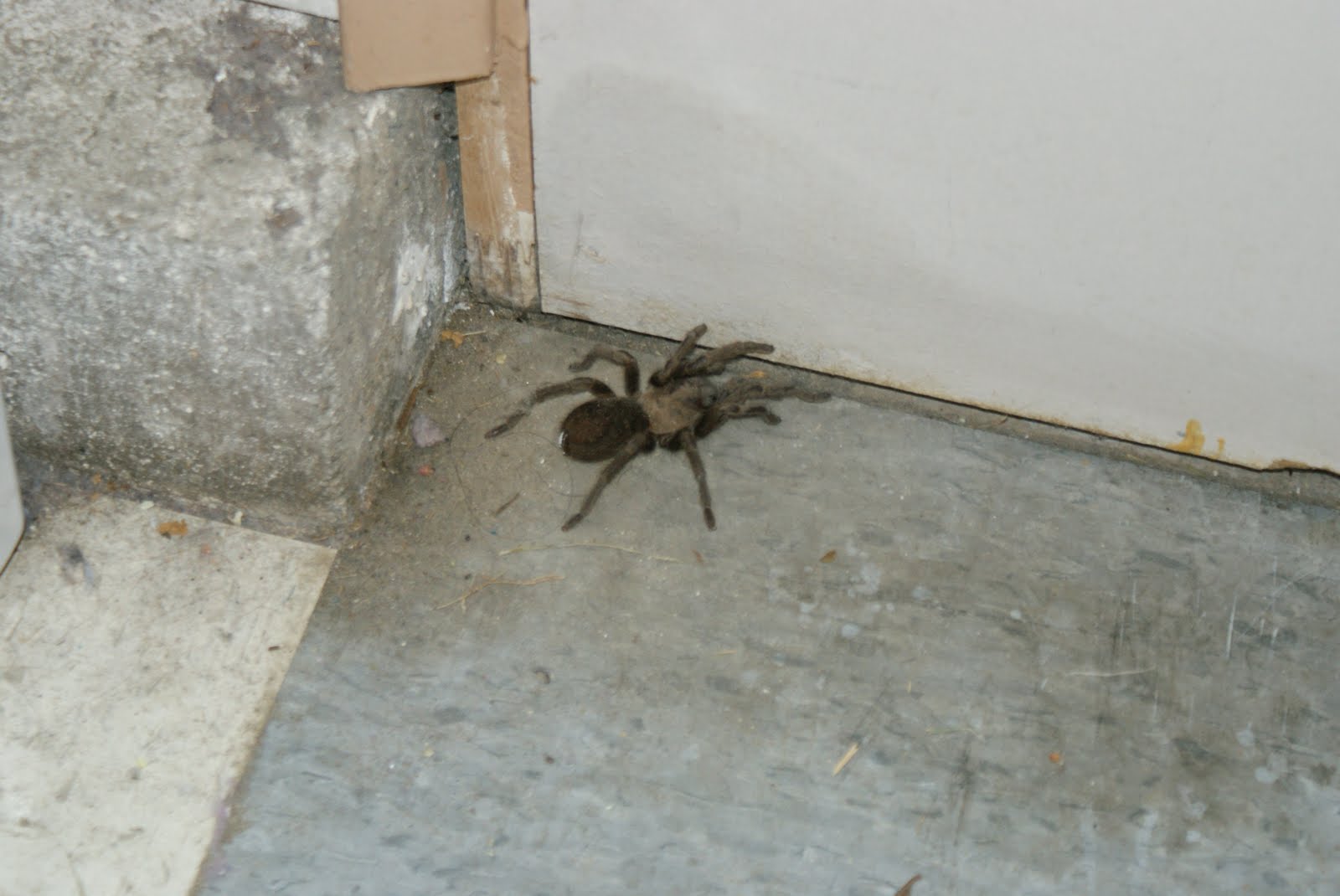
Sorry this post is totally unrelated to beer or homebrewing, but I just had to share. I was taking a keg out of my garage to put outside for cleaning yesterday evening, and found this guy (or girl - I'm not sure which) by my side door. Needless to say my heart skipped a few beats and I think I may have actually screamed like a little girl. That is to say if little girls scream "Holy Sh*t!". I guess these are fairly common in the hills and wilderness around here, but this is the first I've ever seen one.
Maybe it was after my beer. I'll have to name a homebrew after it. Will be releasing it later today out in the hills where my running trail is.
Friday, July 29, 2011
Tuesday, July 19, 2011
2011 Hop Crop
My two year old Nugget hops have taken off like gangbusters this year. It is looking like I may have 10X the amount of hops as last year.
It's funny to see reactions of people who come to my front door when they see the hops. Most people wouldn't know what hop plants look like. But almost everyone seems to know what a marijuana bud looks like. When they see the big hop buds they get a very puzzled/interested look on their faces. "Can this guy really be growing pot in his front yard?!" The A/C repair guys came out last week and I could see them eyeing the hops before I got to the door and questioning each other about what they were. I answered the door and they clammed up. I mentioned that I saw them looking at the plants and mentioned that they were hops for brewing beer. One of them replied - "Oh cool. We thought they were something else - but beer is good too!"
Anyway, here are some photos of my Nugget hops..
It's funny to see reactions of people who come to my front door when they see the hops. Most people wouldn't know what hop plants look like. But almost everyone seems to know what a marijuana bud looks like. When they see the big hop buds they get a very puzzled/interested look on their faces. "Can this guy really be growing pot in his front yard?!" The A/C repair guys came out last week and I could see them eyeing the hops before I got to the door and questioning each other about what they were. I answered the door and they clammed up. I mentioned that I saw them looking at the plants and mentioned that they were hops for brewing beer. One of them replied - "Oh cool. We thought they were something else - but beer is good too!"
Anyway, here are some photos of my Nugget hops..
Wednesday, June 1, 2011
Homebrewing: It's in My Latvian Blood
I was recently leafing through some of the memoirs written by my grandfather, who was from Latvia. Though most of the memoirs are in Latvian and have yet to be translated, there was a particularly interesting passage describing his obligatory entry into Latvian military in 1928. He had been selected for the main headquarters company in Riga, which was tasked with guarding the Presidential palace, Ministry of Defense, and Parliament. He describes his first day as a soldier:
My father had told me that typically, at least in the farming communities where my family was from, beer was brewed by the women of the household as part of the regular cooking and household duties. In addition to brewing for the household, it was especially important for the many different festivals such as the St. John's day celebrations. All the different households would bring their home brewed beers. So there was much variety, both from household to household, but also by region as well.
I've always thought about trying to brew a Latvian style of beer but don't speak Latvian, and haven't been able to find an authentic looking recipe. (Most I have seen are from Estonia or Lithuania) From what I have seen, I imagine the beers were probably wheat based, bittered with whatever flowers or herbs were native to the area. Would appreciate any information, if anyone happens to know of styles or recipes representative of the type of farmhouse beer that would have been brewed in the late 1800's and early 1900's in Latvia.
Uz veselību!
"We repeated the oath being read by the company clerk. We signed the oath with our right hand while holding a rifle in the left. Thus, we became full-fledged soldiers in the Latvian army who would be responsible for order and freedom of Latvia, and give our lives to protect it. Then we paraded in front of the officers. After that we were given a feast: soup, roast, vegetable, rice pudding with cranberry sauce, and a bottle of beer. That was my first bottle of beer that I had tasted. Up to then I had only had home brewed beer."
My father had told me that typically, at least in the farming communities where my family was from, beer was brewed by the women of the household as part of the regular cooking and household duties. In addition to brewing for the household, it was especially important for the many different festivals such as the St. John's day celebrations. All the different households would bring their home brewed beers. So there was much variety, both from household to household, but also by region as well.
I've always thought about trying to brew a Latvian style of beer but don't speak Latvian, and haven't been able to find an authentic looking recipe. (Most I have seen are from Estonia or Lithuania) From what I have seen, I imagine the beers were probably wheat based, bittered with whatever flowers or herbs were native to the area. Would appreciate any information, if anyone happens to know of styles or recipes representative of the type of farmhouse beer that would have been brewed in the late 1800's and early 1900's in Latvia.
Uz veselību!
Friday, November 26, 2010
Brewmasters
I saw the first episode of Brewmasters with Sam Calagione on the Discovery channel last week and was very impressed with the show. I wasn't sure what to expect since I intentionally didn't read any reviews or watch any previews. I have always been a big fan of Dogfish Head beer, and am about halfway through Sam's book: Brewing Up a Business
. If you have some spare time, read this book. Even if you're not into beer,(Then why are you at this site?) it's a great book on entrepreneurship written by someone who doesn't come from the business school norm.
So back to the show. I thought it was fantastic. Not only does Sam do a nice job at explaining basic brewing processes throughout the show, it's funny and you do get a good chance to see the thought processes that go into making great beers. And so far it doesn't seem like they take themselves too seriously. Definitely not beer-snobs by any means.
You really couldn't find a better marketing tool for Dogfish Head than this show. Though it's a pseudo-reality show, I suppose you could also think of it as in infomercial. But not in a bad way. Throughout the entire show the viewer is educated about what it takes to create incredible craft beer. Quality ingredients for sure, but also equal amounts of enthusiasm, creativity, and fun. I think the show will really help build the brand and brand loyalty.
Lastly, considering the show was one big Dogfish Head commercial, I found it a bit ironic and sacrilegious that Blue Moon and Dos Equis ads were very prominent during commercial breaks. Sad that many consumers are going to see those ads and think that Blue Moon is a craft beer.
So back to the show. I thought it was fantastic. Not only does Sam do a nice job at explaining basic brewing processes throughout the show, it's funny and you do get a good chance to see the thought processes that go into making great beers. And so far it doesn't seem like they take themselves too seriously. Definitely not beer-snobs by any means.
You really couldn't find a better marketing tool for Dogfish Head than this show. Though it's a pseudo-reality show, I suppose you could also think of it as in infomercial. But not in a bad way. Throughout the entire show the viewer is educated about what it takes to create incredible craft beer. Quality ingredients for sure, but also equal amounts of enthusiasm, creativity, and fun. I think the show will really help build the brand and brand loyalty.
Lastly, considering the show was one big Dogfish Head commercial, I found it a bit ironic and sacrilegious that Blue Moon and Dos Equis ads were very prominent during commercial breaks. Sad that many consumers are going to see those ads and think that Blue Moon is a craft beer.
Friday, November 5, 2010
Cabernet Saison Update
I kegged my Cabernet Saison last weekend. See the previous post about why on earth anyone would use Cabernet grape juice in beer, as well as how I went about doing it. Though it still needs to finish carbonating and clearing a bit, it tastes awesome.
The Whitelabs Belgian Saison II yeast turned out to give off some very complex flavors. There are absolute spice tones of clove and maybe a little pepper. Surprising how a yeast can give off those flavors. I used no spices in the beer. The Cabernet grapes left very little actual grape flavor, but I do think gave the beer a bit of extra tartness.
I'm not exactly sure what the alcohol (ABV) ended up at, since I'm not sure if I did the calculation right. The problem is after I add the Cabernet juice to secondary, the gravity of course jumps back up and then continues to ferment for a couple weeks until complete. So that throws off the calculations. But I think I figured it out. Maybe a reader can check my work here:
My Original Gravity (OG): 1.058
Final Gravity after Primary Fermentation (Before adding Cabernet juice): 1.012
ABV: 6.0%
After adding Cabernet juice, gravity of beer = 1.018
Final gravity after fermentation with Cabernet juice= 1.011
So to calculate alcohol, I figured I should add the ABV resulting from the added juice to the first OG.
That would mean that the Cabernet juice contributed an extra .91% of ABV. Added to the ABV from primary fermentation (6.0%) would equal total ABV of 6.91% Right?? If anyone thinks different. Please leave a comment.
Also, on a side note, I thought I was being real adventurous here with using the grapes in the beer. I knew that there was a Sam Adams Longshot winner a couple years ago that did a Grape Pale Ale, and I've had Dogfish Head Midas Touch which I think also has grapes. But then last week I had Stone Brewing's Vertical Epic 10.10.10. It is made with Muscat, Sauvingon blanc, and Gewurtztraminer. And now I think I remember seeing a tweet that The Bruery got a shipment of Syrah grapes recently, so I'm assuming there should be a tasty ale with grapes coming from them soon too!!
The Whitelabs Belgian Saison II yeast turned out to give off some very complex flavors. There are absolute spice tones of clove and maybe a little pepper. Surprising how a yeast can give off those flavors. I used no spices in the beer. The Cabernet grapes left very little actual grape flavor, but I do think gave the beer a bit of extra tartness.
I'm not exactly sure what the alcohol (ABV) ended up at, since I'm not sure if I did the calculation right. The problem is after I add the Cabernet juice to secondary, the gravity of course jumps back up and then continues to ferment for a couple weeks until complete. So that throws off the calculations. But I think I figured it out. Maybe a reader can check my work here:
My Original Gravity (OG): 1.058
Final Gravity after Primary Fermentation (Before adding Cabernet juice): 1.012
ABV: 6.0%
After adding Cabernet juice, gravity of beer = 1.018
Final gravity after fermentation with Cabernet juice= 1.011
So to calculate alcohol, I figured I should add the ABV resulting from the added juice to the first OG.
That would mean that the Cabernet juice contributed an extra .91% of ABV. Added to the ABV from primary fermentation (6.0%) would equal total ABV of 6.91% Right?? If anyone thinks different. Please leave a comment.
Also, on a side note, I thought I was being real adventurous here with using the grapes in the beer. I knew that there was a Sam Adams Longshot winner a couple years ago that did a Grape Pale Ale, and I've had Dogfish Head Midas Touch which I think also has grapes. But then last week I had Stone Brewing's Vertical Epic 10.10.10. It is made with Muscat, Sauvingon blanc, and Gewurtztraminer. And now I think I remember seeing a tweet that The Bruery got a shipment of Syrah grapes recently, so I'm assuming there should be a tasty ale with grapes coming from them soon too!!
Saturday, September 25, 2010
Cab Saison
I'm back!! It sure has been a log time since my last post. A new job and a new baby take up a lot of time. That's not to say that I haven't brewed, I just haven't been posting anything. The last few months I have brewed an Imperial Red IPA, and ESB, and fermenting right now is a Pumpkin Brown Porter. I tasted that after primary fermentation, and it is very tasty so far. Halloween should be fun!
This weekend I am brewing an experiment. I have a couple Cabernet grape vines in my backyard that mostly are just for decoration and shade on my patio cover. But I was able to harvest about 5lbs of grapes before the blue jays and mockingbirds got them all. Not enough to make any wine, so I was wondering what I could do with the grapes. My solution is: Cabernet Saison!
I was able to get just about 3/4g of juice from the grapes which I froze until I'm ready to use. I'm just going to brew a 4 gallon batch using some light DME, wheat DME, and steep some crystal 15, maris otter, and munich malt. I'm using White Labs Saison II yeast which is supposed to be a bit more fruity than Saison I. I figured that would complement the Cabernet grapes. My plan is to put the Cabernet juice into my secondary and rack the beer onto the juice. I didn't want to add it to the boil or primary because I want to get the best flavor possible from the juice..
The 500ml yeast starter was started yesterday and it became very active in only about 30 minutes. It is still going strong today. So I can't wait to see this yeast in action for the full batch. Will let you know how it turns out!
This weekend I am brewing an experiment. I have a couple Cabernet grape vines in my backyard that mostly are just for decoration and shade on my patio cover. But I was able to harvest about 5lbs of grapes before the blue jays and mockingbirds got them all. Not enough to make any wine, so I was wondering what I could do with the grapes. My solution is: Cabernet Saison!
I was able to get just about 3/4g of juice from the grapes which I froze until I'm ready to use. I'm just going to brew a 4 gallon batch using some light DME, wheat DME, and steep some crystal 15, maris otter, and munich malt. I'm using White Labs Saison II yeast which is supposed to be a bit more fruity than Saison I. I figured that would complement the Cabernet grapes. My plan is to put the Cabernet juice into my secondary and rack the beer onto the juice. I didn't want to add it to the boil or primary because I want to get the best flavor possible from the juice..
The 500ml yeast starter was started yesterday and it became very active in only about 30 minutes. It is still going strong today. So I can't wait to see this yeast in action for the full batch. Will let you know how it turns out!
Wednesday, April 21, 2010
Happy Birthday To Me!!
This a belated post from my awesome birthday last weekend. Not only did my supercool and beautiful wife (pictured at right) get me a copy of Beer Wars
, (Which I will post a review on later), but she took me to dinner at Haven Gastropub in Old town Orange.
I had heard alot about Haven, from both food and beer angles, and had been wanting to go there for awhile. The restaurant is a modern style english pub that pairs gourmet food with top-notch beers. This isn't your basic fish and chips or bangers and mash. I won't list the menu here, you can visit the site yourself in the link above to view the menu and see what beers they have on tap. Suffice it to say, my steak with Mexican chocolate and cayenne pepper demi-glace was cooked perfect and tasted delicious.
But enough about the food, I was of course really there for the beer. First selection of the night for me was a tulip of Saison Dupont by Brasserie Dupont, a farmhouse brewery in western Belgium. I haven't had alot of experience with the Saison style, so it is hard for me to compare to very much else. But I did really enjoy it. It was blond in color with a nice foamy head and a bit of haze. Smell was what you would expect a farmhouse to smell like- wet wood, bready, and yeasty. The other Saisons I have had have been a little spicy if that's the right word, but this was not quite so. Crisp and tart, but still smooth not overly sour which was good since this was my appetizer beer. All-in-all this is a style I could really get hooked on.
Next I tried the Mikkeller Centennial Single-Hop IPA. (That's me with the IPA to the left) Mikkeller has had a great idea to do a series of IPA's all brewed the same except in each one they use only a single type of hop so you can really taste the hop. I'm very surprised that I didn't much care for it! It's not that it was a bad beer by any means, in fact overall, this was a solid and well crafted IPA. I think the beauty of the single hop idea is that you can really tell which hop profiles you like and which you don't. I think for me, the Centennial may be a bit too pungent and bitter for my taste to have as the aroma and flavor in a beer. I actually use Centennial in my some of my own beers for bittering, but then choose something else for flavor and aroma profiles. In any event, I hope to get a chance someday to try some of their other single hop IPA's such as the Amarillo, Simcoe, Cascade, and Nugget. Actually not sure if any of those are still around anywhere.
Finishing off the night was Cuvée Des Jacobins Rouge by Brouwerij Bockor N.V. in Belgium. It is listed as a Flanders Red Ale. As you can see from the picture to the right, it's a dark red/mahogany color to it, with not a lot of head. Smell is a bit of cherry or berry, I'm not sure. At first taste I thought maybe I tasted fruity cherry or grape, maybe a little vinegar crept in, then BAM! the sour hit me! The more I drank and savored it, the more flavors and levels of sourness appeared. Don't know if that makes any sense. This was by far my favorite beer of the night and I hope to have it again sometime.
While I had grandiose plans to try the BrewDog Tokyo* and Cantillion 2007 Kriek, I had to call it a night as we still needed to go to my in-laws' for dessert and I wanted to still be able to stand. Tokyo* at 18.2% would have floored me for the night. (I'm still a lightweight after all these years). And I couldn't quite bring myself to fork over $55 for a 25oz bottle of Cantillion since I would just be drinking that myself. Would rather have that one to share with someone, and my wife wasn't up for that one right then.
So, it was a very Happy Birthday for me. I'm a lucky man.
I had heard alot about Haven, from both food and beer angles, and had been wanting to go there for awhile. The restaurant is a modern style english pub that pairs gourmet food with top-notch beers. This isn't your basic fish and chips or bangers and mash. I won't list the menu here, you can visit the site yourself in the link above to view the menu and see what beers they have on tap. Suffice it to say, my steak with Mexican chocolate and cayenne pepper demi-glace was cooked perfect and tasted delicious.
But enough about the food, I was of course really there for the beer. First selection of the night for me was a tulip of Saison Dupont by Brasserie Dupont, a farmhouse brewery in western Belgium. I haven't had alot of experience with the Saison style, so it is hard for me to compare to very much else. But I did really enjoy it. It was blond in color with a nice foamy head and a bit of haze. Smell was what you would expect a farmhouse to smell like- wet wood, bready, and yeasty. The other Saisons I have had have been a little spicy if that's the right word, but this was not quite so. Crisp and tart, but still smooth not overly sour which was good since this was my appetizer beer. All-in-all this is a style I could really get hooked on.
Next I tried the Mikkeller Centennial Single-Hop IPA. (That's me with the IPA to the left) Mikkeller has had a great idea to do a series of IPA's all brewed the same except in each one they use only a single type of hop so you can really taste the hop. I'm very surprised that I didn't much care for it! It's not that it was a bad beer by any means, in fact overall, this was a solid and well crafted IPA. I think the beauty of the single hop idea is that you can really tell which hop profiles you like and which you don't. I think for me, the Centennial may be a bit too pungent and bitter for my taste to have as the aroma and flavor in a beer. I actually use Centennial in my some of my own beers for bittering, but then choose something else for flavor and aroma profiles. In any event, I hope to get a chance someday to try some of their other single hop IPA's such as the Amarillo, Simcoe, Cascade, and Nugget. Actually not sure if any of those are still around anywhere.
Finishing off the night was Cuvée Des Jacobins Rouge by Brouwerij Bockor N.V. in Belgium. It is listed as a Flanders Red Ale. As you can see from the picture to the right, it's a dark red/mahogany color to it, with not a lot of head. Smell is a bit of cherry or berry, I'm not sure. At first taste I thought maybe I tasted fruity cherry or grape, maybe a little vinegar crept in, then BAM! the sour hit me! The more I drank and savored it, the more flavors and levels of sourness appeared. Don't know if that makes any sense. This was by far my favorite beer of the night and I hope to have it again sometime.
While I had grandiose plans to try the BrewDog Tokyo* and Cantillion 2007 Kriek, I had to call it a night as we still needed to go to my in-laws' for dessert and I wanted to still be able to stand. Tokyo* at 18.2% would have floored me for the night. (I'm still a lightweight after all these years). And I couldn't quite bring myself to fork over $55 for a 25oz bottle of Cantillion since I would just be drinking that myself. Would rather have that one to share with someone, and my wife wasn't up for that one right then.
So, it was a very Happy Birthday for me. I'm a lucky man.
Wednesday, April 14, 2010
The Hop Guardians
I looked out this morning to see a couple of mourning doves hanging out in my hopyard. Looks to me like they are protecting the Willamette hops.
Friday, March 26, 2010
Top Cropping Yeast from a Carboy
Sometimes I'm a cheapskate. I know it's not a huge expense to get a new vial of yeast to brew, but I see no reason not to reuse yeast when possible. When harvesting yeast from a batch of beer, there's many ways to do it. You can pitch a new batch of wort on top of the yeast cake from a previous batch. I've done this a few times and it works real well and you get a good fermentation, but I'm always a bit skeptical of pitching on top of the old trub. I'm just afraid that all the old junk will give some off flavors. Plus I have read that the best yeast to use if you are going to harvest, is the top yeast in the krauesen. If you are using a bucket, that yeast is easy to spoon off., but fermenting in a carboy makes it difficult to get at the yeast.
So I rigged up a system to top crop the yeast in a carboy using a racking cane, some tubing, a jar, and an airlock. It works like a blow-off tube, but doesn't blow off into a sanitizer solution to be discarded. Instead, you blow off fresh yeast into a sanitized container that is fitted with an airlock so you can keep the yeast. The idea is to insert the racking cane into the carboy so the bottom is just above the top of the fermenting beer, where the foamy krausen will be. The cane is connected to tubing that runs down into a sanitized jar fitted with an airlock. So once fermentation starts, the pressure will push the foam out through the racking cane and down into that collection jar. I also like to collect a little beer into the jar as well. To do this just push the racking cane down into the carboy further.
.jpg)
.jpg)
So I rigged up a system to top crop the yeast in a carboy using a racking cane, some tubing, a jar, and an airlock. It works like a blow-off tube, but doesn't blow off into a sanitizer solution to be discarded. Instead, you blow off fresh yeast into a sanitized container that is fitted with an airlock so you can keep the yeast. The idea is to insert the racking cane into the carboy so the bottom is just above the top of the fermenting beer, where the foamy krausen will be. The cane is connected to tubing that runs down into a sanitized jar fitted with an airlock. So once fermentation starts, the pressure will push the foam out through the racking cane and down into that collection jar. I also like to collect a little beer into the jar as well. To do this just push the racking cane down into the carboy further.
.jpg)
.jpg)
I've also seen people use this method with a 1000ml Erlenmeyer flask fitted with a two port carboy cap. But like I said above, I'm thrifty. So for this batch at least, I used what I had on hand. Here is a photo of fresh new top cropped yeast as it is collected in the sanitized jar:
After collecting enough yeast, the racking cane is removed from the carboy and replaced with an airlock. Then if I'm using the yeast within a few days, I just put some plastic wrap over the top of the jar with a rubber band and put it in the refrigerator. Or for slightly longer storage, I bottle it in a sanitized bottle.
The most I've ever reused yeast is three batches, and haven't had any problems yet. If I had more sanitary conditions, better temperature control, and better equipment, it would be possible to use it for more batches. I think for now three or four generations is about all I want to risk before mutations and infections occur.
UPDATE:
I upgraded my collection equipment so now it's not quite as hillbilly. I bought an Erlenmeyer flask and some better carboy caps (5Gallon cap fits on the Erlynmeyer and 6Gallon cap for the Better Bottle). I also bought a PET racking cane and cut it a bit shorter so the overall height of the setup isn't as high. Mainly a space and aesthetic issue. But overall, I think this system is more solid and with the better fittings, should be no leaks in the system.
So after one night my Pumpkin Porter fermentation filled the flask. I got lucky and was able to switch out the flask with a blow-ff bucket before the flask totally overflowed as well. Here is a picture of a 1000ml flask filled with fresh bubbly White Labs Burton Ale yeast topcropped from my Pumpkin Porter!
UPDATE:
I upgraded my collection equipment so now it's not quite as hillbilly. I bought an Erlenmeyer flask and some better carboy caps (5Gallon cap fits on the Erlynmeyer and 6Gallon cap for the Better Bottle). I also bought a PET racking cane and cut it a bit shorter so the overall height of the setup isn't as high. Mainly a space and aesthetic issue. But overall, I think this system is more solid and with the better fittings, should be no leaks in the system.
So after one night my Pumpkin Porter fermentation filled the flask. I got lucky and was able to switch out the flask with a blow-ff bucket before the flask totally overflowed as well. Here is a picture of a 1000ml flask filled with fresh bubbly White Labs Burton Ale yeast topcropped from my Pumpkin Porter!
Wednesday, March 24, 2010
Farmhouse Ale Experiment
A few weeks ago a had the pleasure of drinking a bottle of Lost Abbey's Avant Garde farmhouse ale. I really enjoyed this beer, and noticed quite a bit of sediment at the bottom of the bottle. Thought it would be interesting to see if I could harvest the yeast from the bottle and brew something up with it.The big question, which I still don't know the answer to, is whether Lost Abbey uses the same yeast to bottle with as they use for primary fermentation. Probably not, but so what. I tried it anyway.
When I poured the beer, I was careful to not disturb the sediment and left about a half inch of beer in the bottle as well. Then I put the cork back in and set it in the refrigerator for a few days until I had some time to brew up a starter. When I finally had time, I got the bottle from the fridge and let it sit out at room temperature for a few hours. Then I brewed up a small wort using a couple pints of water, about 1 1/2 cups light dry malt extract, some yeast nutrient and a few hop pellets. Once cooled I poured this into my sterilized bottle and shook it for a few minutes to aerate. Then I swirled the sediment around in the Lost Abbey bottle, popped the cork out and poured the sediment into my starter bottle. On went the airlock and all was set to see what would happen in the next few hours(hopefully), or days.
Next morning I took a peek out in the garage: nothing happening. A few days pass, and no bubbles from the airlock, and no foam in the bottle. I check the temperature and it's about 64 degrees. The Lost Abbey website says the yeast for this beer is a house lager strain that they use at ale temperature. So I figured 64 was probably ok. A few more days went by and still nothing. I figured at this point the experiment failed, and went about other things.
A couple more days went by, and as I was fishing a beer out of the garage fridge, I noticed out of the corner of my eye that there was some white forming in the yeast starter over in the area I ferment my beer. I thought to myself, "oh great the mold is setting in". I didn't want to mess with it, so I left it. Then the next morning I went out to dump the starter and to my surprise I had a fermentation going! The white stuff I had barely looked at before was actually the first foamy bubbles as the yeast finally started getting active. I checked the temperature, and it was now about 68 degrees in my little cave/corner in the garage. So maybe those extra few degrees where what the yeast needed to get a kick start? Here are a couple photos of the yeast starter:
All looked good, so I decided to go forward with the experiment. I brewed up a small 3 gallon batch of wort and pitched this yeast starter into it. This time primary fermentation started up within an hour or two and is now slowing down on its third day. The krausen looks real good, and the smell coming from the airlock smells like beer. Maybe there is a little sulfury/banana smell? Hard to tell. But since this is supposedly a lager yeast I would expect it to smell quite a bit different from the Cal and American Ale yeast I usually use.
So I'm keeping my fingers crossed that this will be drinkable and actually taste good. I plan to condition it for a month or so then bottle it and maybe taste it after another month in the bottle. I'll update the post when I try the beer. Cheers!
When I poured the beer, I was careful to not disturb the sediment and left about a half inch of beer in the bottle as well. Then I put the cork back in and set it in the refrigerator for a few days until I had some time to brew up a starter. When I finally had time, I got the bottle from the fridge and let it sit out at room temperature for a few hours. Then I brewed up a small wort using a couple pints of water, about 1 1/2 cups light dry malt extract, some yeast nutrient and a few hop pellets. Once cooled I poured this into my sterilized bottle and shook it for a few minutes to aerate. Then I swirled the sediment around in the Lost Abbey bottle, popped the cork out and poured the sediment into my starter bottle. On went the airlock and all was set to see what would happen in the next few hours(hopefully), or days.
Next morning I took a peek out in the garage: nothing happening. A few days pass, and no bubbles from the airlock, and no foam in the bottle. I check the temperature and it's about 64 degrees. The Lost Abbey website says the yeast for this beer is a house lager strain that they use at ale temperature. So I figured 64 was probably ok. A few more days went by and still nothing. I figured at this point the experiment failed, and went about other things.
A couple more days went by, and as I was fishing a beer out of the garage fridge, I noticed out of the corner of my eye that there was some white forming in the yeast starter over in the area I ferment my beer. I thought to myself, "oh great the mold is setting in". I didn't want to mess with it, so I left it. Then the next morning I went out to dump the starter and to my surprise I had a fermentation going! The white stuff I had barely looked at before was actually the first foamy bubbles as the yeast finally started getting active. I checked the temperature, and it was now about 68 degrees in my little cave/corner in the garage. So maybe those extra few degrees where what the yeast needed to get a kick start? Here are a couple photos of the yeast starter:
All looked good, so I decided to go forward with the experiment. I brewed up a small 3 gallon batch of wort and pitched this yeast starter into it. This time primary fermentation started up within an hour or two and is now slowing down on its third day. The krausen looks real good, and the smell coming from the airlock smells like beer. Maybe there is a little sulfury/banana smell? Hard to tell. But since this is supposedly a lager yeast I would expect it to smell quite a bit different from the Cal and American Ale yeast I usually use.
So I'm keeping my fingers crossed that this will be drinkable and actually taste good. I plan to condition it for a month or so then bottle it and maybe taste it after another month in the bottle. I'll update the post when I try the beer. Cheers!
Subscribe to:
Posts (Atom)


.jpg)

